Table of Contents
- 1. Iztapalapa’s Passion Play celebrates Mesoamerican heritage
- 2. Historical Origins of the Iztapalapa Passion Play
- 3. Significance of the UNESCO Designation
- 4. The Structure of the Passion Play
- 4.1 Community Involvement in Organization
- 4.2 Timeline of Events During Holy Week
- 5. Cultural Heritage and Mesoamerican Roots
- 6. The Role of Participants in the Passion Play
- 7. The Economic Impact of the Passion Play
- 8. Challenges Facing the Iztapalapa Passion Play
- 8.1 Managing Crowds and Safety
- 8.2 Maintaining Authenticity Amid Commercialization
- 9. The Rituals and Symbolism of the Passion Play
- 10. Intergenerational Transmission of Tradition
Iztapalapa’s Passion Play celebrates Mesoamerican heritage
Iztapalapa’s UNESCO-Recognized Holy Week
– Where it happens: Iztapalapa, a Mexico City borough whose Holy Week scenes play out in streets, plazas, and the ascent of Cerro de la Estrella (Huizachtitlan).
– How big it is: Reporting that cites local records puts attendance at up to ~2 million spectators in some years, with 5,000+ participants involved.
– Why it matters: The reenactment blends Catholic devotion with a landscape shaped by pre-Hispanic sacred history—one reason it was inscribed by UNESCO in December 2025.
– Freshness cue: The 2026 reenactment is widely described as the first Holy Week performance to take place after the UNESCO designation.
- Born from a community vow during a 19th-century epidemic, Iztapalapa’s Passion Play has grown into one of Latin America’s largest Holy Week observances.
- In December 2025, UNESCO inscribed the Iztapalapa Passion Play on its Intangible Cultural Heritage of Humanity list, amplifying global attention.
- The reenactment unfolds across streets and plazas, culminating in a Good Friday Via Crucis up Cerro de la Estrella—an ancient sacred landscape.
- Its power lies in local ownership: thousands of residents organize, perform, and transmit the tradition across generations.
This overview is based on Mexico News Daily’s reporting on the tradition and its historical context.
Historical Origins of the Iztapalapa Passion Play
From Devotion to Annual Renewal
1) 1687 (local devotion takes root): A pilgrimage tradition centers on El Señor de la Cuevita, a Christ image associated with a cave shrine.
2) 1833 (the vow): During a cholera epidemic, residents promise an annual Holy Week commemoration if the crisis ends.
3) 1843 (the expansion): The commemoration grows into a full public dramatization of the Passion—street theater tied to neighborhood organization.
4) Year after year (the renewal): The promise is reaffirmed through repeated rehearsal, performance, and community stewardship.
Checkpoint to watch for as you read: the tradition’s “origin story” is both historical (epidemic, dates) and devotional (a vow renewed annually)—and the play’s meaning depends on holding both together.
Iztapalapa’s famed Passion Play traces its roots to crisis and collective promise. During a devastating cholera epidemic in 1833, residents turned to El Señor de la Cuevita—a revered Christ image associated with a cave shrine—and vowed to stage an annual Holy Week commemoration if the calamity ended. Local memory holds that the epidemic soon passed, binding the community to a ritual obligation renewed each year.
By 1843, the observance had evolved into a full public dramatization of the Passion of Christ. What began as devotional procession expanded into a large-scale street theater that merges liturgy, performance, and neighborhood organization—an event now synonymous with Iztapalapa’s identity in Mexico City.
Significance of the UNESCO Designation
UNESCO Recognition: Benefits and Pressures
What UNESCO recognition can strengthen
– Safeguarding and visibility: More attention can translate into stronger documentation, support for organization, and pride in local heritage.
– Cultural continuity: The “living tradition” framing reinforces that the play is sustained by community governance and intergenerational transmission.
What it can pressure
– Crowd and route management: Bigger audiences raise the stakes for safety, access, and coordination.
– Commercial pull: More visitors can intensify the temptation to treat the play as entertainment first.
– Local control: Institutional interest can be helpful, but the tradition’s credibility depends on decisions staying anchored in the community.
UNESCO’s December 2025 designation of the Iztapalapa Passion Play as Intangible Cultural Heritage of Humanity formalized what residents have long asserted: this is not merely a spectacle, but a living tradition sustained by community governance, shared labor, and intergenerational transmission.
The inscription also shifts the play’s public profile. International recognition tends to increase tourism, media coverage, and institutional interest—bringing resources and prestige, but also intensifying pressure to manage crowds, protect the event’s meaning, and keep decision-making anchored locally.
The Structure of the Passion Play
Staged in the open air, the Iztapalapa Passion Play is both a religious observance and a logistical feat. It draws up to around 2 million spectators in some years, according to local records cited in reporting, and involves more than 5,000 participants, including roughly 150 speaking roles.
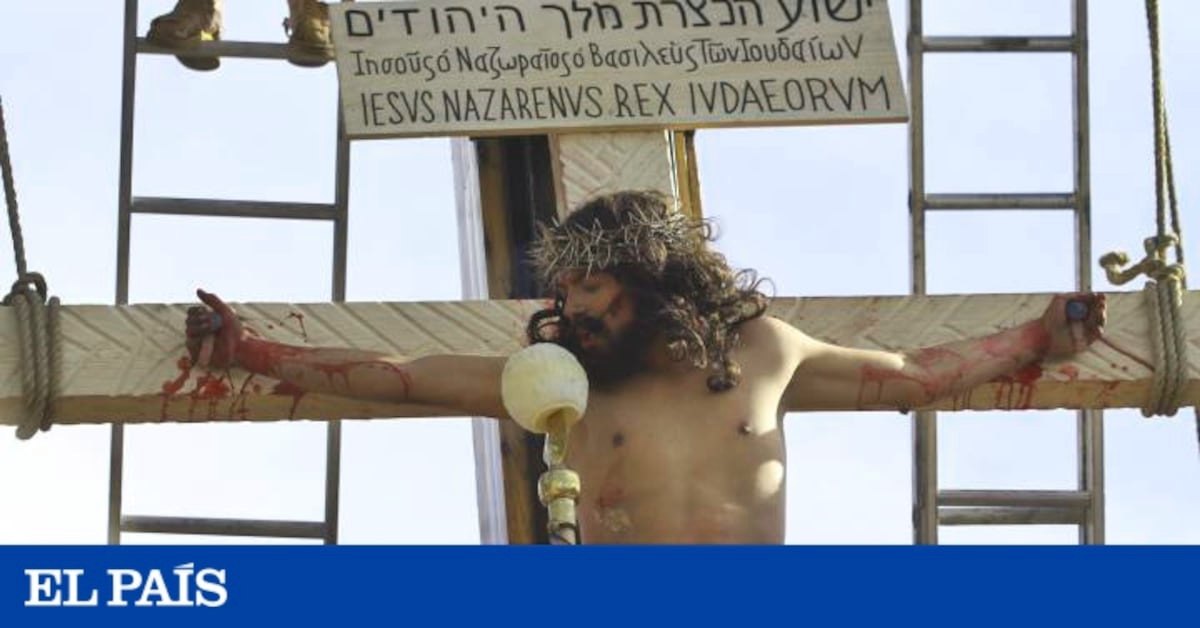
The narrative follows the 14 stations of the Via Crucis, from condemnation to burial, with the most physically demanding sequences performed under the midday sun. The Good Friday climax—often featuring a heavy wooden cross and barefoot procession—turns the borough itself into a moving stage.
| Holy Week segment | What typically happens | Where it plays out | What to notice |
|---|---|---|---|
| Palm Sunday | Opening processions and early scenes begin | Streets and public spaces across Iztapalapa | The event is already “borough-wide,” not confined to one venue |
| Midweek scenes | Episodes leading to the Passion (staged biblical moments) | Plazas and neighborhood streets | The crowd moves with the story; scenes are designed for public viewing |
| Good Friday: Via Crucis | The 14 stations culminate in the crucifixion staging | Procession routes + Cerro de la Estrella ascent and hilltop area | Physical endurance (heat, distance, carrying the cross) is part of the devotional intensity |
Community Involvement in Organization
The production is organized locally, with residents handling casting, rehearsals, costumes, staging, and coordination with public services. This community-led model is central to the play’s endurance: it is not imported programming but neighborhood stewardship, shaped by long-standing norms about who may perform key roles and how the ritual should be conducted.
Around the performance, a market and fair operate alongside the devotional core—an arrangement that underscores how Holy Week in Iztapalapa functions as both communal rite and major public gathering.
Timeline of Events During Holy Week
While details vary year to year, the Passion Play unfolds across Holy Week, building toward Good Friday:
- Palm Sunday: processions and early scenes begin in public spaces across the borough.
- Midweek: staged episodes depict key moments leading to the Passion, drawing crowds through plazas and streets.
- Good Friday: the Via Crucis is performed through the streets and culminates on Cerro de la Estrella, where the crucifixion scene is staged.
Cultural Heritage and Mesoamerican Roots
Layers of Sacred Tradition
A useful way to read Iztapalapa’s Holy Week is through three overlapping layers:
1) Sacred place (where): Cerro de la Estrella/Huizachtitlan and the surrounding barrios—routes and staging that turn geography into meaning.
2) Sacred time (when): Cycles of renewal—Holy Week’s annual return alongside older ideas of calendrical “reset.”
3) Sacred action (how): Public procession, endurance, and communal witnessing—ritual done collectively, not privately.
When these layers align, the play feels less like a “performance in a city” and more like a tradition that is of the landscape.
Iztapalapa’s Holy Week cannot be separated from its deeper geography. Long before Mexico City expanded into a modern metropolis, Iztapalapa was a pre-Hispanic settlement neighboring Tenochtitlán, positioned at a crucial boundary between the freshwater systems linked to Xochimilco and the saltwater of Lake Texcoco.
At the center of this landscape stands Cerro de la Estrella (Huizachtitlan), a site associated with the Mexica New Fire ceremony (El Fuego Nuevo)—a ritual of cosmic renewal held every 52 years, tied to the synchronization of calendrical cycles. Nahuatl translator and researcher Rodrigo Ortega Acoltzi describes elaborate processions, music, and ceremonial performance on the hill.
“Time is renewed every 52 years in pre-Hispanic Anáhuac. Existence itself was renewed every 52 years. This comes from the coordination of the two Mexica Calendars. One is the agricultural calendar (360 days plus 5), and the other is the divinatory calendar (260 days). This renewal represents going back to the moment when the world was created,” says the specialist.
The Passion Play’s resonance is sharpened by these continuities of place and theme: pilgrimage routes, collective gathering, and the idea that sacred time is renewed through public ritual.
The Role of Participants in the Passion Play
Behind-the-Scenes Passion Play Team
Who makes the Passion Play work (beyond what spectators see):
– Principal cast: Jesus, Mary, apostles, and other speaking roles (the most physically and emotionally demanding parts).
– Large ensemble: Residents portraying Roman soldiers, townspeople, and attendants—crucial for scale and realism.
– Route and crowd stewards: People positioned along the procession path to keep movement possible and protect performers.
– Costume/prop teams: Building, maintaining, and moving items (including large wooden crosses and set pieces).
– Care and support volunteers: Water distribution, shade/heat relief where possible, and basic coordination during long hours.
– Organizers and neighborhood leadership: The local backbone that schedules rehearsals, sets norms, and keeps the vow’s tone intact.
For performers, the Passion Play is not treated as ordinary acting. The person cast as Jesus is expected to embody endurance and discipline, and the physical demands of the Via Crucis—heat, distance, and the weight of the cross—are part of the event’s devotional intensity.
Beyond principal roles, the scale depends on thousands of residents who appear as apostles, Roman soldiers, townspeople, and attendants, as well as volunteers who manage costumes, props, water distribution, and coordination along the route. The result is a civic-religious collaboration in which participation itself is a form of belonging.
The Economic Impact of the Passion Play
| Who tends to benefit | How the Passion Play translates into income | What shapes the outcome |
|---|---|---|
| Food and drink vendors | High-volume sales during long viewing hours | Foot traffic concentration along routes and plazas |
| Artisans and souvenir sellers | Purchases tied to pilgrimage/visit memory | Visitor mix (locals vs. tourists) and permitted vending areas |
| Transport (taxis, rides, public transit nodes) | Increased trips to/from Iztapalapa during peak days | Road closures, crowd density, and timing of major scenes |
| Neighborhood shops and services | Spillover demand for basics (water, snacks, supplies) | Proximity to staging areas and ability to stay open |
| Temporary/seasonal workers | Short-term jobs supporting stalls, cleanup, and logistics | Scale of the market/fair and local hiring practices |
Holy Week in Iztapalapa generates a surge of local commerce. The accompanying market brings income to vendors, artisans, food sellers, and service providers, while the influx of visitors supports transport, temporary employment, and neighborhood businesses.
This economic dimension is inseparable from the event’s scale: when crowds reach into the millions, even small transactions—meals, drinks, souvenirs, basic supplies—become a significant seasonal boost. Estimates about total economic impact vary widely depending on what’s counted (direct sales vs. broader spillover), but the local reality is consistent: Holy Week is a major income moment for many families and small businesses. The challenge is ensuring that benefits remain rooted in the community that produces the tradition.
Challenges Facing the Iztapalapa Passion Play
Managing Scale, Safety, and Meaning
Operational pressure points that show up repeatedly in reporting and local practice:
– Scale: Attendance is often described as reaching 1–2 million spectators in some years, which turns ordinary streets into high-density corridors.
– Human logistics: The play involves thousands of participants (with 150 or so speaking roles), meaning coordination is as critical as performance.
– Route risk: The Good Friday movement and the Cerro de la Estrella ascent concentrate crowds and raise the stakes for access and response.
– Order and safety measures: Public-order steps (such as restrictions on alcohol sales during Holy Week, noted in general descriptions of the event) reflect how seriously organizers and authorities treat crowd conditions.
– Meaning under pressure: UNESCO-era visibility can intensify commercialization and “spectacle” framing—exactly the tension organizers work to resist.
The Passion Play’s success creates its own vulnerabilities. As attendance grows and global recognition increases, organizers face the dual task of protecting participants and preserving meaning.
Managing Crowds and Safety
With streets packed for hours and processions moving through dense urban corridors, crowd control is a constant concern. The event requires coordination across routes, medical response capacity, and clear passage for performers. The sheer number of spectators can strain infrastructure and complicate emergency access—especially during the Good Friday ascent and hilltop staging.
Maintaining Authenticity Amid Commercialization
UNESCO recognition can attract new audiences, but it can also encourage a shift in tone—from vow and devotion toward “must-see” entertainment. Organizers must balance the fair-like atmosphere around the play with the solemnity of the ritual itself, resisting pressures to shorten, sensationalize, or repackage scenes for outside consumption.
The Rituals and Symbolism of the Passion Play
Motifs Shaping Sacred Meaning
Three recurring motifs help decode the play’s symbolism as you watch/read:
– Suffering as devotion: Endurance (heat, distance, carrying the cross) isn’t just theatrical realism—it’s part of how participants express faith.
– Renewal through return: The annual repetition functions like a communal “reset,” reaffirming the 1833 vow and re-centering the community.
– Sacred geography: Places—especially Cerro de la Estrella and the cave devotion of El Señor de la Cuevita—anchor meaning in the local landscape.
The Passion Play’s symbolism operates on multiple registers. At its surface, it reenacts the Christian narrative of suffering, death, and burial. But in Iztapalapa, the ritual also echoes older patterns of sacred performance tied to the landscape.
The theme of sacrifice—physical pain, endurance, and public witnessing—creates a bridge between Catholic Passion devotion and Mesoamerican ceremonial logics in which bodily offering and communal participation carried cosmic weight. The theme of renewal is equally central: Holy Week becomes a yearly reset, a reaffirmation of the 1833 vow, and a communal return to foundational stories.
Caves add another layer. In Mesoamerican traditions, caves were powerful sacred spaces—linked to fertility and the underworld. The devotion to El Señor de la Cuevita, rooted in a cave shrine, anchors the Passion Play in a local sacred geography that predates colonial Christianity even as it now expresses Catholic faith.
Intergenerational Transmission of Tradition
From Helper to Leader
How the tradition is typically handed down (and where it can falter):
1) Watching (childhood): Kids absorb the rhythm—rehearsals, routes, and the “rules of respect” around key scenes.
2) Helping (early teens): Small tasks (costumes, props, water, coordination) turn spectators into contributors.
3) Participating (teens to adults): Ensemble roles build confidence and familiarity with timing, movement, and crowd conditions.
4) Leading (adulthood): Experienced participants take on organizing responsibilities and mentor newcomers.
Checkpoint: continuity depends less on any single star performer and more on whether each generation has clear on-ramps from helper → participant → organizer.
The Passion Play persists because it is taught, not merely staged. Knowledge moves through families, barrios, and organizing committees: how to build and maintain costumes, how to manage routes, how to perform scenes, and how to uphold the event’s devotional tone.
Children grow up watching relatives rehearse and volunteer; adolescents enter as minor roles or helpers; adults take on responsibility in organization and performance. This continuity—practical, emotional, and spiritual—is what turns a yearly event into a durable cultural system.
The Enduring Legacy of Semana Santa in Iztapalapa
Iztapalapa’s Passion Play endures because it is both memory and present tense: a vow made in crisis, renewed in public, and mapped onto a landscape where older sacred histories still shape meaning.
Cultural Significance and Community Identity
For residents, the Passion Play is a declaration of local identity within a vast capital city. It transforms streets into shared space, elevates neighborhood cooperation into public art, and frames faith as something enacted collectively rather than consumed privately. The result is a tradition that functions as a living archive—of devotion, of place, and of community governance.
Future Prospects and Challenges Ahead
UNESCO recognition offers a platform to strengthen safeguarding and support local stewardship, but it also raises the stakes. The future of the Passion Play will depend on whether organizers can keep control in community hands while adapting to larger crowds, heavier media attention, and the economic temptations that come with global visibility.
What has carried Iztapalapa this far—collective responsibility, reverence for place, and the annual renewal of a promise—will likely determine whether the tradition remains a ritual first, and a spectacle only second.
This piece reflects the blog’s focus on practical, trustworthy Mexico City context for travelers—an approach shaped by Martin Weidemann’s long-running work in digital transformation and service design, where clear information and local stewardship matter.
This note reflects publicly available information at the time of writing. Attendance, routes, and on-the-ground measures can change year to year due to weather, security planning, and local organizing decisions. While the UNESCO inscription timing is widely reported, public summaries may vary in how they describe safeguarding responsibilities. For the latest logistics, consult local announcements and official borough communications.

Martin Weidemann is a digital transformation expert and entrepreneur with over 20 years of experience leading fintech and innovation projects. As a LinkedIn Top Voice in Digital Transformation and contributor to outlets like Forbes, he now brings that same expertise to travel and mobility in Mexico City through Mexico-City-Private-Driver.com. His focus: trustworthy service, local insights, and peace of mind for travelers.