
Table of Contents
- 1. Iztapalapa’s Passion Play celebrates Mesoamerican heritage
- 2. Historical Background of the Passion Play in Iztapalapa
- 3. Significance of the Passion Play as Intangible Cultural Heritage
- 4. Annual Celebration and Community Involvement
- 4.1 Participants and Roles
- 4.2 Preparatory Activities
- 5. Structure and Sequence of the Passion Play
- 5.1 Key Events During Holy Week
- 5.2 The Role of the Nazarenes
- 6. Cultural and Mesoamerican Influences
- 7. Impact of the Passion Play on Local Identity
- 8. Challenges Facing the Passion Play Today
- 9. Future of the Passion Play in Iztapalapa
- 10. The Enduring Legacy of Semana Santa in Iztapalapa
Iztapalapa’s Passion Play celebrates Mesoamerican heritage
Sacred Renewal at Cerro de la Estrella
Semana Santa in Iztapalapa is staged on a landscape where Catholic Holy Week and older Mesoamerican ideas of renewal sit side by side. The Via Crucis climbs toward Cerro de la Estrella (Huizachtitlan), a hill long associated with cyclical “new beginning” ceremonies, so the setting itself quietly reinforces the week’s themes of suffering, passage, and return.
- Staged annually since 1843, Iztapalapa’s Passion Play grew from a community vow made during the 1833 cholera epidemic.
- In December 2025, UNESCO inscribed the representation of the Passion, Death, and Resurrection of Christ in Iztapalapa as Intangible Cultural Heritage of Humanity.
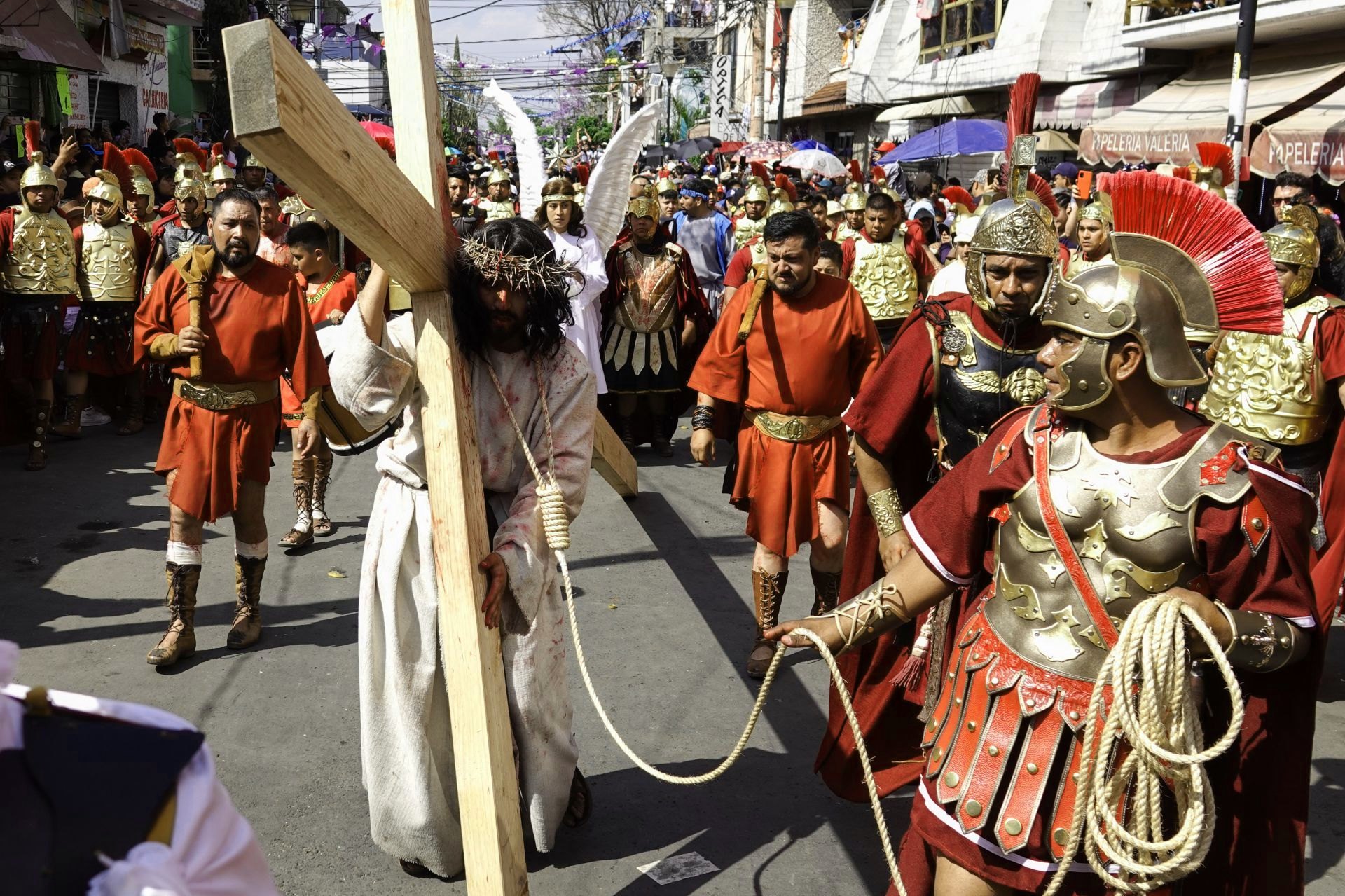
- The Good Friday Via Crucis draws up to around 2 million spectators in some years and mobilizes more than 5,000 local participants.
- The performance unfolds on streets and culminates at Cerro de la Estrella—an ancient ceremonial landscape tied to the Mexica “New Fire” renewal rite.
- Catholic devotion and Mesoamerican ritual logics—pilgrimage, sacrifice, renewal, and sacred geography—interlace throughout the week.
Historical Background of the Passion Play in Iztapalapa
From Local Vow to Tradition
Origin timeline (local vow → annual tradition)
– 1687: A pilgrimage from Oaxaca is associated (in local tradition) with the appearance of El Señor de la Cuevita in a cave sanctuary near Cerro de la Estrella.
– 1833: During a cholera epidemic, residents make a vow to reenact the Passion each Holy Week if the crisis ends.
– 1843: The reenactment becomes established as an annual, community-run representation and continues year after year.
Iztapalapa’s Semana Santa is among the most widely attended religious dramatizations in the Americas, but its origin story is intensely local. In 1833, as cholera swept through the area, residents turned to a revered image known as El Señor de la Cuevita (the Lord of the Little Cave), associated with a cave sanctuary near Cerro de la Estrella. According to local tradition, the community promised to reenact the Passion of Christ each Holy Week if the epidemic ended. Mexico News Daily’s reporting also notes that locals made this promise in 1833 and have kept it annually since 1843. When the crisis passed, the vow became a yearly obligation—and a collective identity marker.
The dramatized representation has been performed continuously since 1843, evolving from procession into a large-scale street theater that stages the Passion narrative in public space. Over time, the event expanded into a multi-day sequence, with Good Friday as its emotional and logistical peak: the Via Crucis, following the 14 stations, moves through the borough .
Significance of the Passion Play as Intangible Cultural Heritage
UNESCO Recognition of Iztapalapa Tradition
UNESCO recognition (Dec 2025) — what’s being recognized
– Inscribed element: “Representation of the Passion, Death and Resurrection of Christ in Iztapalapa.”
– Why it matters: UNESCO frames it as living heritage sustained by community knowledge, collective organization, and intergenerational transmission.
– Primary reference: UNESCO Intangible Cultural Heritage listing (Representative List): https://ich.unesco.org/en/RL/representation-of-the-passion-death-and-resurrection-of-christ-in-iztapalapa-02237
UNESCO’s December 2025 inscription recognized Iztapalapa’s Passion Play as a living tradition sustained by community knowledge, intergenerational transmission, and collective organization. The designation refers to the representation of the Passion, Death, and Resurrection of Christ in Iztapalapa.
The designation also underscores what residents have long asserted: this is not simply a performance for visitors. It is a civic-religious system—part devotion, part neighborhood governance, part cultural memory—kept alive through volunteer labor, strict role selection, and a shared sense of custodianship. The first Holy Week reenactment after the UNESCO recognition carried added symbolic weight, spotlighting both pride and the pressure to preserve meaning amid global attention.
Annual Celebration and Community Involvement
The scale is vast: more than 5,000 people participate, with roughly 150 speaking roles, and crowds can reach into the millions. Alongside the dramatization, the borough hosts a market and fair that transform the area into a dense corridor of commerce, food, and pilgrimage. (Attendance estimates vary by year and by how sources count spectators versus total visitors; local reporting has cited figures as high as about 2 million spectators in some years.)
A defining feature is that the tradition is organized locally—rooted in Iztapalapa’s historic barrios and sustained by residents who treat the event as a communal duty rather than a seasonal spectacle.
| What scales up each year | What it looks like on the ground | Why it matters for the tradition |
|---|---|---|
| Local participants | More than 5,000 people involved across acting, logistics, and support | Keeps the event community-owned rather than outsourced |
| Speaking roles | Roughly 150 speaking roles | Requires training, discipline, and continuity of know-how |
| Spectators/visitors | Crowds can reach into the millions | Drives logistics needs (routes, safety, sanitation, mobility) |
| Organizing structure | Local organizing committees coordinating routes, costumes, staging, and volunteers | Turns devotion into a repeatable civic system |
| Public-space ecosystem | Market and fair alongside the dramatization | Blends pilgrimage, commerce, and neighborhood life in one corridor |
Participants and Roles
Casting is both practical and moral in tone. The actor portraying Jesus carries the heaviest symbolic burden, but the production depends on a full civic cast: Roman soldiers, disciples, religious authorities, narrators, and a large body of penitents.
The event’s most visible mass participation comes from the Nazarenes: men and women in purple robes who join the procession carrying wooden crosses as an act of devotion and penance. Their presence turns the Via Crucis into a moving congregation, blurring the line between audience and ritual actor.
Preparatory Activities
Preparation is not a rehearsal sprint; it is a long build. Organizing committees coordinate logistics, costumes, routes, crowd management, and staging across multiple days and sites. The work includes training for principal roles, costume-making, and the coordination of volunteers who manage everything from processions to public order.
The result is a production that looks monumental because it is: a year’s worth of planning condensed into a week of public ritual.
Structure and Sequence of the Passion Play
Iztapalapa’s Holy Week follows a recognizable Christian arc—entry, betrayal, trial, crucifixion, and resurrection—yet its staging is inseparable from the borough’s geography. Streets become sets; neighborhoods become chapters; the hill becomes a culminating altar of public memory.
Key Events During Holy Week
| Day | What happens | Where the intensity peaks |
|---|---|---|
| Palm Sunday | Processions that establish the narrative and the community’s participation | Neighborhood streets as the “opening chapter” |
| Holy Thursday | Last Supper and the arrest | Night scenes and crowd flow management |
| Good Friday | Trial, Via Crucis (14 stations), and crucifixion | Long route + midday heat + Cerro de la Estrella climb |
| Holy Saturday | Vigil and anticipation | Transition from mourning to renewal |
| Easter Sunday | Celebration and closing | Community closure and return to everyday life |
The sequence typically begins on Palm Sunday with processions that establish the narrative and the community’s participation. Holy Thursday stages the Last Supper and the arrest. Good Friday concentrates the largest crowds and the most physically demanding scenes: the trial, the Via Crucis through the streets, and the crucifixion at Cerro de la Estrella. Holy Saturday and Easter Sunday complete the cycle with vigil and celebration.
This structure is both theatrical and devotional: scenes are performed, but they are also endured—especially under the midday sun, on long routes, and in acts of penance that are voluntary yet intense.
The Role of the Nazarenes
The Nazarenes are the Passion Play’s moral chorus. Carrying crosses—sometimes extremely heavy—many walk barefoot or under self-imposed hardship. Their participation reframes the event from a dramatization watched at a distance into a collective act of embodied faith.
In practice, they also shape the event’s visual identity: the purple robes, the crosses, and the slow-moving procession create an image that has become synonymous with Iztapalapa’s Semana Santa in national and international media.
Cultural and Mesoamerican Influences
Holy Week Ritual Parallels
How the week “rhymes” with older ritual logics (parallels, not equivalences)
– Pilgrimage & procession: Following the Via Crucis through the borough echoes older processional movement toward a charged ceremonial center.
– Sacrifice & embodied hardship: Voluntary penance (barefoot walking, carrying crosses) mirrors the broader Mesoamerican emphasis on physical cost as ritual seriousness.
– Renewal & cyclical time: Holy Week’s death-to-resurrection arc aligns with renewal themes associated with Huizachtitlan/Cerro de la Estrella.
– Sacred geography: Streets, barrios, and the hill function as a ritual map—space is part of the meaning, not just the backdrop.
– Caves as thresholds: The story of El Señor de la Cuevita resonates with long-standing cave symbolism as portals and fertility-linked sacred sites.
Iztapalapa’s Holy Week cannot be separated from its pre-Hispanic landscape. Long before the Passion Play, the area was a significant settlement in the Basin of Mexico, positioned between freshwater and saltwater systems and anchored by Huizachtitlan—today’s Cerro de la Estrella.
That hill was the site of the Mexica New Fire ceremony (El Fuego Nuevo), a renewal rite performed every 52 years to mark the synchronization of calendrical cycles and the continuation of cosmic time. Researchers describe elaborate processions, music, and ritual action culminating in the lighting of a new fire—an act of renewal tied to sacrifice and rebirth. Nahuatl translator and researcher Rodrigo Ortega Acoltzi describes this calendrical renewal as the coordination of two Mexica calendars—an agricultural cycle and a divinatory cycle—through which “existence itself was renewed every 52 years.”
The Passion Play resonates with these older ritual logics without collapsing into them. The parallels are structural rather than doctrinal: pilgrimage and procession, sacred geography, the centrality of suffering, and the idea that communal continuity is secured through repeated, public ceremony. Even the story of El Señor de la Cuevita—a Christ image linked to a cave—echoes the deep Mesoamerican sacrality of caves as portals, wombs of fertility, and thresholds to other worlds.
Impact of the Passion Play on Local Identity
Belonging and Pride in Iztapalapa
An identity lens for Iztapalapa
– Belonging: Participation is a public way of saying “I’m from here,” not just “I attended.”
– Intergenerational continuity: Skills (costume-making, organizing, performing) and responsibilities are inherited as much as roles.
– Borough pride: The hill, the route, and the barrios become a shared map of local authority within Mexico City.
For Iztapalapa, the Passion Play is a yearly act of self-definition. It asserts that the borough is not merely a peripheral district of Mexico City but a place with its own ceremonial center, history, and authority.
The event also functions as social glue. Families and neighbors pass down roles, skills, and responsibilities; participation becomes a form of belonging. The streets used for daily life become a shared stage where the community narrates itself—through faith, discipline, and collective labor—before the eyes of the city and the world.
Challenges Facing the Passion Play Today
Balancing Faith, Access, and Safety
– Devotion vs. spectacle: Bigger audiences and cameras can reward “performance moments,” even when participants experience the week primarily as a vow and an act of faith.
– Open access vs. community control: Welcoming outsiders brings energy and economic activity, but it can also complicate local decision-making and crowd behavior.
– Crowds vs. infrastructure: Millions of visitors intensify pressure on transport, sanitation, emergency response, and route management.
– Tradition vs. adaptation: Safety, public health, and city growth require adjustments, but too much change can dilute what residents recognize as “their” Semana Santa.
Success brings strain. Massive attendance pressures infrastructure, mobility, sanitation, and security. Media attention can tilt incentives toward spectacle, risking a shift from devotional focus to performance-first expectations.
There is also the challenge of continuity in a changing city: sustaining volunteer labor, maintaining rigorous preparation, and ensuring younger generations inherit not just the roles but the reasons behind them. Recent history has shown vulnerability, too—public health disruptions during the COVID-19 era forced unprecedented changes, revealing how deeply the event depends on physical gathering.
UNESCO recognition elevates the tradition, but it also raises the stakes: global visibility can amplify both support and scrutiny.
Future of the Passion Play in Iztapalapa
Stewardship in the UNESCO Era
What “stewardship” looks like in the UNESCO era (practical checkpoints)
– Transmission: Keep training pathways for speaking roles, organizers, and artisans visible to younger residents.
– Route & crowd planning: Re-check bottlenecks each year (heat exposure, steep segments, entry/exit points) as attendance shifts.
– Meaning-first decisions: When adding logistics or media access, test whether it supports the vow and the ritual flow—or distracts from it.
– Community governance: Preserve local authority over casting, staging, and rules so the tradition doesn’t drift into an external production.
The Passion Play’s future will likely hinge on a careful balance: welcoming visitors while keeping decision-making and meaning rooted in the community that created the tradition. The strongest safeguard remains the same force that built it—local stewardship, transmitted through practice rather than proclamation.
If organizers can manage growth without surrendering control, the UNESCO era may provide resources and attention that help protect the event’s material needs—training, costumes, logistics—while reinforcing its intangible core: a communal promise renewed each year in public.
The Enduring Legacy of Semana Santa in Iztapalapa
Cultural Significance and Community Identity
Iztapalapa’s Semana Santa endures because it is more than a reenactment. It is a living contract between past and present: a vow born in epidemic fear, sustained through generations, and staged on a landscape where older Mesoamerican ideas of renewal still haunt the contours of the hill.
In that sense, the Passion Play is both memory and method—how a community gathers, organizes, and reaffirms itself through shared ritual.
Future Challenges and Opportunities
The central question is not whether the event will draw crowds—it will—but whether it can preserve its internal logic: devotion over display, community authority over external demand, and continuity over novelty.
Its opportunity is equally clear. With global recognition and deep local roots, Iztapalapa’s Passion Play can remain what it has long been: a public ceremony where faith, history, and Mesoamerican geography converge—year after year, step after step, up the Cerro de la Estrella.
This piece is written from the perspective of Martin Weidemann, a digital transformation expert focused on trustworthy travel and mobility in Mexico City, with an emphasis on clear context and local insight for visitors.
Attendance figures can differ by year and by how they’re defined (spectators versus total visitors), so totals should be treated as approximate. Public information and local practices may change over time, particularly after major recognitions such as UNESCO inscriptions. For visit planning, confirm the latest local guidance on routes, access points, and day-of logistics.

Martin Weidemann is a digital transformation expert and entrepreneur with over 20 years of experience leading fintech and innovation projects. As a LinkedIn Top Voice in Digital Transformation and contributor to outlets like Forbes, he now brings that same expertise to travel and mobility in Mexico City through Mexico-City-Private-Driver.com. His focus: trustworthy service, local insights, and peace of mind for travelers.